How traditional Taekwondo reached southern Brazil
From Porto Alegre in 1974 to Balneário Camboriú: how traditional Taekwondo reached southern Brazil, with Korean masters and the 1987 state federation.
Taekwondo reached southern Brazil on August 1, 1974, through Porto Alegre, brought by Korean master Yong Man Kim; three years later came Grão-Mestre (Grandmaster) Te Bo Lee, who in 1987 founded the Federação Gaúcha de Taekwondo (the Rio Grande do Sul Taekwondo Federation) and made the state a technical reference on the continent. That school produced teachers who took the sport to other states, among them Mestre Paulo Ribeiro, Brazilian champion in 1990 and, for more than two decades, based in Balneário Camboriú. This article traces that path, from Porto Alegre to the Santa Catarina coast, using only what is documented. Quotes from Portuguese sources are our own translation.
1974: the first Korean master in Porto Alegre
According to the Federação Gaúcha de Taekwondo “about us” page, Master Yong Man Kim started the practice in the state on August 1, 1974, creating a Taekwondo Department within the Federação Riograndense de Pugilismo (the Rio Grande do Sul Boxing Federation), the body that then hosted boxing. The first State Championship took place in August 1976, at the IPA Gym in Porto Alegre.
Master Kim’s career was short. According to the text by Grão-Mestre Alexandre Gomes published by IBAM, he died in an accident in 1978. The sport, however, already had another leader.
1977: the arrival of Grão-Mestre Te Bo Lee
Again according to the IBAM text, Te Bo Lee came to Brazil in 1977 at the invitation of the Confederação Brasileira de Pugilismo (Brazilian Boxing Confederation), passed through Rio de Janeiro and went on to Porto Alegre to replace Master Sung Myung Choi, who moved to Brasília. The Federação Gaúcha sums up the same moment in one sentence: in 1977 the Grão-Mestre “came from Korea, choosing our state to develop Taekwondo”.
Who this master was, where he came from and how he trained is in the article on Grão-Mestre Te Bo Lee. For this story, what matters is what he built in the years that followed.
1987: the Federação Gaúcha and the state as a reference
In 1987, the Grão-Mestre founded the Federação Gaúcha de Taekwondo, which the organization itself describes as the official governing body of the sport in the state. A report by Beta Redação, the student newsroom of Unisinos university, states that under his leadership Rio Grande do Sul became a technical reference in South America, alongside São Paulo.
The same report describes the early 1990s as the period when the Rio Grande do Sul team became a national powerhouse, citing first place by team at the 2nd Taça dos Mestres (Masters’ Cup), in São Paulo, with athletes such as Alexandre Gomes, In Kyu Lee, Liandro Pimentel, Vinícius Salvato and André Gimenez. The IBAM text points the same way and records the state as four-time Brazilian champion in the 1990s.
It was in this setting, on October 21, 1990, that Paulo Ribeiro won the welterweight category of the 13th Brazilian Men’s Taekwondo Championship, held in Porto Alegre. His relationship with the Grão-Mestre and the list of standout students on which he appears are in the article on Mestre Paulo Ribeiro’s lineage.
1994: the split that still exists
Beta Redação records that in 1994 the Federação Gaúcha lost athletes because of “political factors”, giving rise to a split that persists. Today more than one organization coexists in the state. The Federação Gaúcha de Taekwondo states on its website that the sport is present in more than 100 cities in Rio Grande do Sul, with about 12,000 practitioners and 250 black belts, and that since 2003 it has been chaired by Master Olzemir Antonio Machado. Grão-Mestre Te Bo Lee, for his part, was described in August 2023 by Rádio Taquara as president of the Federação Gaúcha de Taekwondo Tradicional (Rio Grande do Sul Traditional Taekwondo Federation).
The relationship between the two organizations has not been confirmed by an open source, and this article does not take sides: it records what each one publishes about itself.
Why “traditional”
The word appears in the name of the federation chaired by the Grão-Mestre and, in Taekwondo, usually refers to an emphasis on complete technical training, with forms, fundamentals and etiquette, not just competition sparring. Mestre Paulo’s posts, in turn, mention FETESC, the Federação de Taekwondo do Estado de Santa Catarina (Santa Catarina State Taekwondo Federation), linked to the Olympic competition system. The two worlds do not exclude each other: the same teacher can train black belts the traditional way and take athletes to championships. How Mestre Paulo prefers to describe his own work has not been confirmed, so this site does not give him a label.
From Porto Alegre to inland Rio Grande do Sul
Before reaching the Santa Catarina coast, Mestre Paulo trained students in Rio Grande do Sul. In August 2019, on a trip to the north of the state, he posted two reunions. In Erechim, with Roberto Meneguine, a 3rd Dan black belt, whom he called “one of the pioneers of Taekwondo in Erechim” (Instagram). And with Marcelo Godoy, introduced as “my black belt student”, who, in his words, was “shaking up Passo Fundo” (Instagram). These posts show that the Grão-Mestre’s lineage, passing through Mestre Paulo, also took root outside the capital.
Santa Catarina: Balneário Camboriú as a new base
In October 2020, Mestre Paulo wrote that he had been in Balneário Camboriú “for more than 20 years”, “working with children and adults of all ages” (Instagram). The exact date of the move has not been confirmed, but the period coincides with the start of the tournament he organizes in the city: the Open BC Taekwondo Cup, whose 17th edition was in 2015 and 25th in 2024, as shown in the article on the 20th Open BC Taekwondo Cup.
In Santa Catarina, the Mestre works within the state federation’s structure. In July 2018, he celebrated a student’s “official black belt recognition in the state of SC” (Instagram). In October of the same year, while preparing students for the year-end exam, he noted “FETESC expanding into western Santa Catarina” (Instagram). In other words, the cycle he lived as a student in Rio Grande do Sul, with official exams and a federation panel, is the same one he reproduces with his Santa Catarina students.
What has not yet been confirmed
To keep to this site’s standard, here are the points without an open source:
- the date Mestre Paulo moved to Balneário Camboriú and the year of the first Open BC;
- how Taekwondo reached Santa Catarina and when FETESC was founded, topics not found in an official source in this research;
- the current relationship between the Federação Gaúcha de Taekwondo and the Federação Gaúcha de Taekwondo Tradicional;
- the spelling of Master Kim’s name, which appears as Yong Man Kim at the Federação Gaúcha and with a different spelling in the IBAM text.
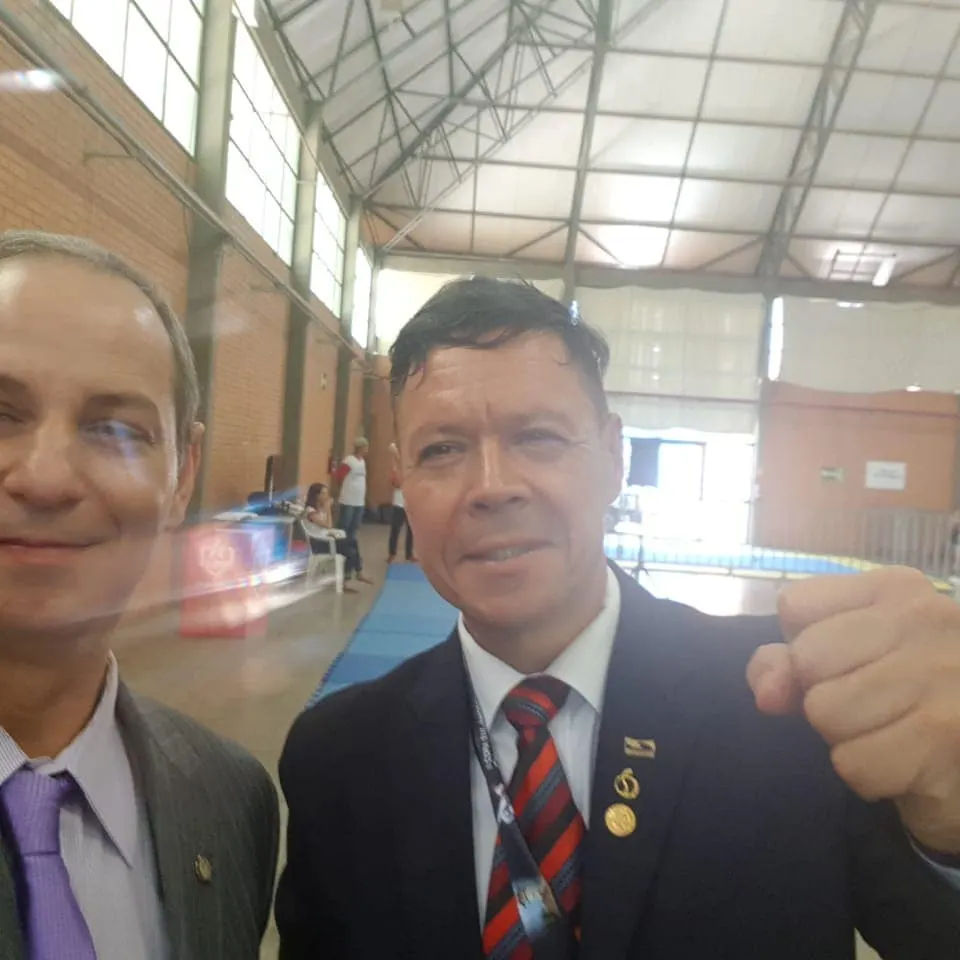
The photo illustrating this article shows Mestre Paulo with Grão-Mestre Alexandre Gomes, his training partner at the same dojang since the 1980s, in Nova Petrópolis (RS), in 2018.
Train with someone who learned at the source
A Taekwondo school is the sum of the masters who shaped it. Read Mestre Paulo’s story and contact him on Instagram @mestrepauloribeiro to book a trial class in Balneário Camboriú.
Frequently asked questions
When did Taekwondo arrive in Rio Grande do Sul?
On August 1, 1974, with Master Yong Man Kim, who created a Taekwondo Department within the Federação Riograndense de Pugilismo, according to the Federação Gaúcha de Taekwondo. Grão-Mestre (Grandmaster) Te Bo Lee arrived in 1977.
When was the Federação Gaúcha de Taekwondo founded?
In 1987, by Grão-Mestre Te Bo Lee, as the official governing body of the sport in the state, according to the federation’s own website.
What does traditional Taekwondo mean?
It is the name used by the federation chaired by Grão-Mestre Te Bo Lee, the Federação Gaúcha de Taekwondo Tradicional. Mestre Paulo’s posts mention FETESC, the Santa Catarina federation linked to the Olympic line. How he prefers to describe himself has not been confirmed.
How did Mestre Paulo Ribeiro come to Santa Catarina?
He was Brazilian champion in Porto Alegre in 1990 and, according to a 2020 post, had been in Balneário Camboriú for more than 20 years. The exact date of the move has not been confirmed.
Sources
- Federação Gaúcha de Taekwondo – About us
- The history of Taekwondo in Rio Grande do Sul – Beta Redação (Unisinos), December 9, 2024
- Taekwondo in RS, text by Grão-Mestre Alexandre Gomes – IBAM
- Athletes from Riozinho and Rolante stand out at a Taekwondo competition in Itati – Rádio Taquara, August 24, 2023
- Post on official black belt recognition in SC – Instagram, July 21, 2018
- Post on FETESC in western Santa Catarina – Instagram, October 11, 2018
- Post “Me and my life with sport” – Instagram, October 14, 2020
- Reunion with Roberto Meneguine in Erechim – Instagram, August 17, 2019
- Reunion with Marcelo Godoy, from Passo Fundo – Instagram, August 17, 2019
Want to support the project?
See how companies and people in Brazil support sport through their taxes, or talk directly to the Master.
Read next
Kukkiwon: what it is and why it matters for your black belt
What is Kukkiwon: Taekwondo’s world headquarters in Seoul, founded in 1972, and the difference between a school black belt and a Dan registered there.
· 5 min read
What is Hapkido? The Korean art of self-defense
What is Hapkido: the Korean self-defense art Grão-Mestre Te Bo Lee teaches alongside Taekwondo. Origins, techniques and differences, no hype.
· 5 min read
Mestre Paulo Ribeiro’s lineage: from Kukkiwon to Balneário Camboriú
Who taught Mestre Paulo Ribeiro Taekwondo? The lineage runs through Grão-Mestre Te Bo Lee, the Kukkiwon and southern Brazil to Balneário Camboriú.
· 5 min read