What is Hapkido? The Korean art of self-defense
What is Hapkido: the Korean self-defense art Grão-Mestre Te Bo Lee teaches alongside Taekwondo. Origins, techniques and differences, no hype.
Hapkido is a Korean martial art of self-defense that combines joint locks, throws, pins, kicks and punches. Unlike Taekwondo, which focuses on kicks and point fighting, Hapkido was designed to neutralize an attacker at close range, turning the attacker’s strength against them. It appears on this site for a reason of lineage: Grão-Mestre (Grandmaster) Te Bo Lee, Mestre Paulo Ribeiro’s master, holds ranks in both arts and teaches both in Porto Alegre. This article explains what Hapkido is, where it came from, how it differs from Taekwondo and what has not yet been confirmed about its practice in Balneário Camboriú.
What Hapkido is
According to English Wikipedia, Hapkido is a hybrid Korean martial art focused on self-defense that uses joint locks, grappling, chokes, throws, kicks, punches and other strikes. The name is usually translated as “the way of coordinated energy” or “the way of harmony”.
In practice, this means the student learns to respond to a grab, a push or a punch in three combined ways: getting out of the line of attack, controlling the attacker’s joint (wrist, elbow, shoulder) and taking them to the ground or pinning them. Kicks and punches are there, but they are not the core of the system as they are in Taekwondo.
Where it came from
The same source states that Hapkido has no single creator: it grew out of the collective effort of the first students of Choi Yong-sool, a Korean who returned from Japan bringing techniques from Daitō-ryū Aiki-jūjutsu, a Japanese school of locks and throws. It was one of these students, Ji Han-jae, who adopted the name “hapkido” in 1957. The art took hold in South Korea in the following decades, alongside Taekwondo.
A common point of confusion: Hapkido and Aikido share the same origin in the characters of their names, but they are different arts. Aikido is Japanese and avoids strikes; Hapkido is Korean and includes kicks and punches in its repertoire.
Hapkido and Taekwondo: what changes
Both arts were born in Korea in the same period and are often taught by the same masters, but they have different goals.
- Distance. Taekwondo works mainly at medium and long range, with kicks as the main weapon. Hapkido works at close range: the attacker has already grabbed, already pushed or is one step away.
- Core technique. In Taekwondo, kicks, punches and, in the Olympic form, scoring with strikes to the chest protector and the head. In Hapkido, locks, twists, throws and control on the ground.
- Competition. Taekwondo is an Olympic sport, with rules for sparring and forms. Hapkido is practiced mainly as self-defense, without the same competition circuit.
- Complement. That is why many Korean instructors teach both: Taekwondo for the athletic base and stand-up fighting; Hapkido for situations where stand-up fighting is no longer enough.
How Taekwondo works in Balneário Camboriú is explained on the Taekwondo page.
Hapkido in Mestre Paulo’s lineage
The text by Grão-Mestre Alexandre Gomes published by IBAM describes Grão-Mestre Te Bo Lee as a “9th dan in taekwondo and hapkido” and states that he teaches both arts, having earned degrees, after the age of 50, in physical education, physical therapy and acupuncture. A July 2012 post on the Taekwondo Fred blog already introduced him as “Grão Mestre Te Bo Lee 9º Dan” in content about Hapkido. In December 2025, a YouTube video shows the Grão-Mestre demonstrating a Hapkido technique.
The Grão-Mestre’s Instagram profile presents the Centro Esportivo Mestre Te Bo Lee, in Porto Alegre, with Taekwondo and Hapkido classes and acupuncture sessions. His full biography is in the article about Grão-Mestre Te Bo Lee.
Mestre Alexandre Gomes, Mestre Paulo’s fellow student at the same dojang (training hall) since the 1980s, follows the same path. In November 2018, Mestre Paulo posted a photo with him and called him the “leader of Hapkido and Taekwondo in RS”, the state of Rio Grande do Sul (Instagram). In other words, in the school Mestre Paulo comes from, Hapkido is not an add-on: it is the house’s second art. The full chain of masters is in the article about Mestre Paulo Ribeiro’s lineage.
What Hapkido teaches about self-defense
Even people who will never practice Hapkido can take away three ideas the art makes clear.
- Defense starts before the strike. Posture, distance and awareness prevent most situations. Technique comes in when prevention has failed.
- Use the other person’s strength. Locks and throws work because they redirect the attacker’s movement, not because the defender is stronger. That is what makes the art accessible to smaller people.
- Control, don’t just hit. Pinning someone and getting out of the situation is usually safer than trading blows.
These ideas also guide the self-defense work Mestre Paulo does within his Taekwondo classes, with emphasis on distance, escapes from grabs and conditioning.
What has not yet been confirmed
To keep to this site’s standard:
- it has not been confirmed whether Mestre Paulo Ribeiro holds a rank in Hapkido or whether he offers a dedicated class in the art in Balneário Camboriú;
- the Grão-Mestre’s biography on IBAM is signed by one of his students and has not been found in an independent second source;
- the story of Choi Yong-sool and his first students comes from a secondary source, Wikipedia, which records differing versions of his training in Japan.
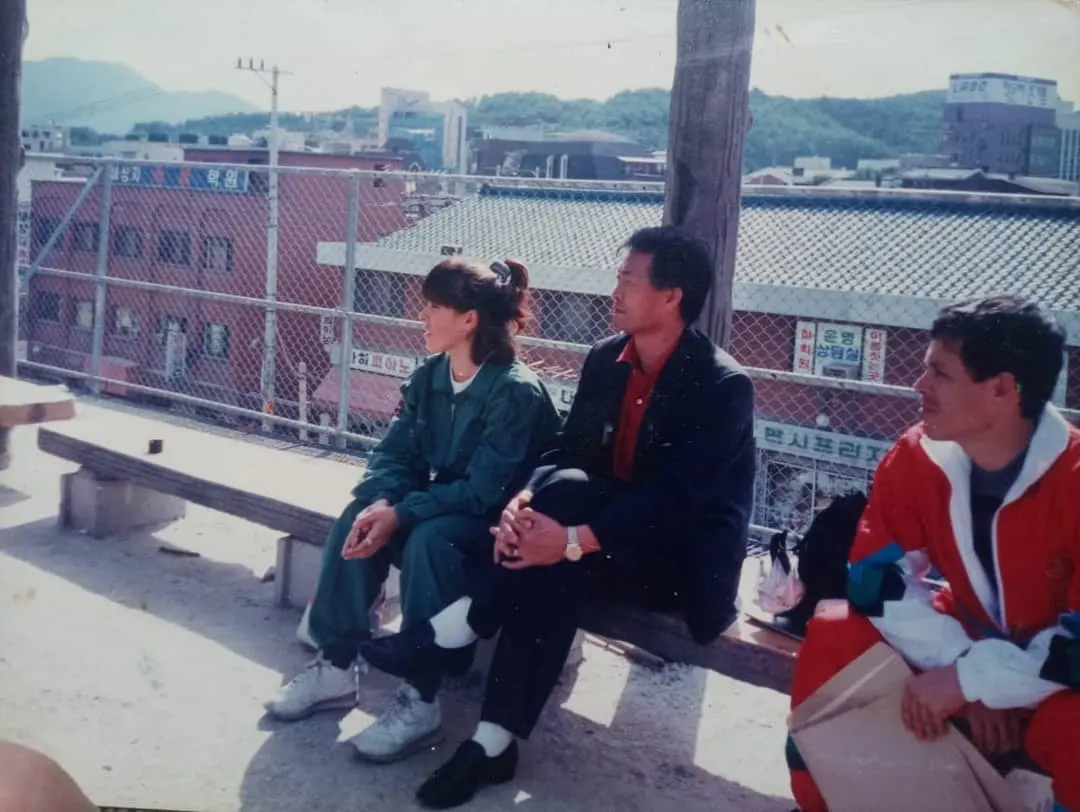
The photo illustrating this article is an old picture of Mestre Paulo in South Korea, posted by him in 2019; it does not show a Hapkido class.
Want self-defense with a Korean foundation?
If your goal is to learn to defend yourself, the way in at Balneário Camboriú is Mestre Paulo’s Taekwondo classes, which work on distance, kicks and escapes from grabs. Read the Mestre’s story and contact him on Instagram @mestrepauloribeiro to find out which class is right for you.
Frequently asked questions
Are Hapkido and Taekwondo the same thing?
No. Both are Korean arts, but Taekwondo focuses on kicks, punches and, in its Olympic form, point fighting. Hapkido is a self-defense art that combines joint locks, throws, pins, kicks and punches.
Is Hapkido the same as Aikido?
No. The names share the same origin in their written characters, but they are different arts: Aikido is Japanese and Hapkido is Korean, with a repertoire that includes strikes and kicks.
Does Mestre Paulo Ribeiro teach Hapkido in Balneário Camboriú?
This has not been confirmed. What is documented is that his master, Grão-Mestre (Grandmaster) Te Bo Lee, teaches Taekwondo and Hapkido in Porto Alegre. In Balneário Camboriú, self-defense is covered within the Taekwondo classes.
Who created Hapkido?
According to English Wikipedia, there is no single creator: the art grew out of the collective effort of Choi Yong-sool’s first students, and the name Hapkido was adopted by Ji Han-jae in 1957.
Sources
- Hapkido – English Wikipedia
- Taekwondo no RS, text by Grão-Mestre Alexandre Gomes – IBAM
- Grão Mestre Te Bo Lee 9º Dan – Taekwondo Fred blog, July 2012
- Hapkido technique video with Grão-Mestre Te Bo Lee – YouTube, December 7, 2025
- Grão-Mestre Te Bo Lee’s Instagram profile
- Post with Mestre Alexandre Gomes – Mestre Paulo Ribeiro, Instagram, November 10, 2018
Want to support the project?
See how companies and people in Brazil support sport through their taxes, or talk directly to the Master.
Read next
Kukkiwon: what it is and why it matters for your black belt
What is Kukkiwon: Taekwondo’s world headquarters in Seoul, founded in 1972, and the difference between a school black belt and a Dan registered there.
· 5 min read
How traditional Taekwondo reached southern Brazil
From Porto Alegre in 1974 to Balneário Camboriú: how traditional Taekwondo reached southern Brazil, with Korean masters and the 1987 state federation.
· 6 min read
Mestre Paulo Ribeiro’s lineage: from Kukkiwon to Balneário Camboriú
Who taught Mestre Paulo Ribeiro Taekwondo? The lineage runs through Grão-Mestre Te Bo Lee, the Kukkiwon and southern Brazil to Balneário Camboriú.
· 5 min read