Taekwondo for children: what the research really shows
Taekwondo for children benefits: what three clinical trials show about attention, self-control and behavior, with the limits of each study.
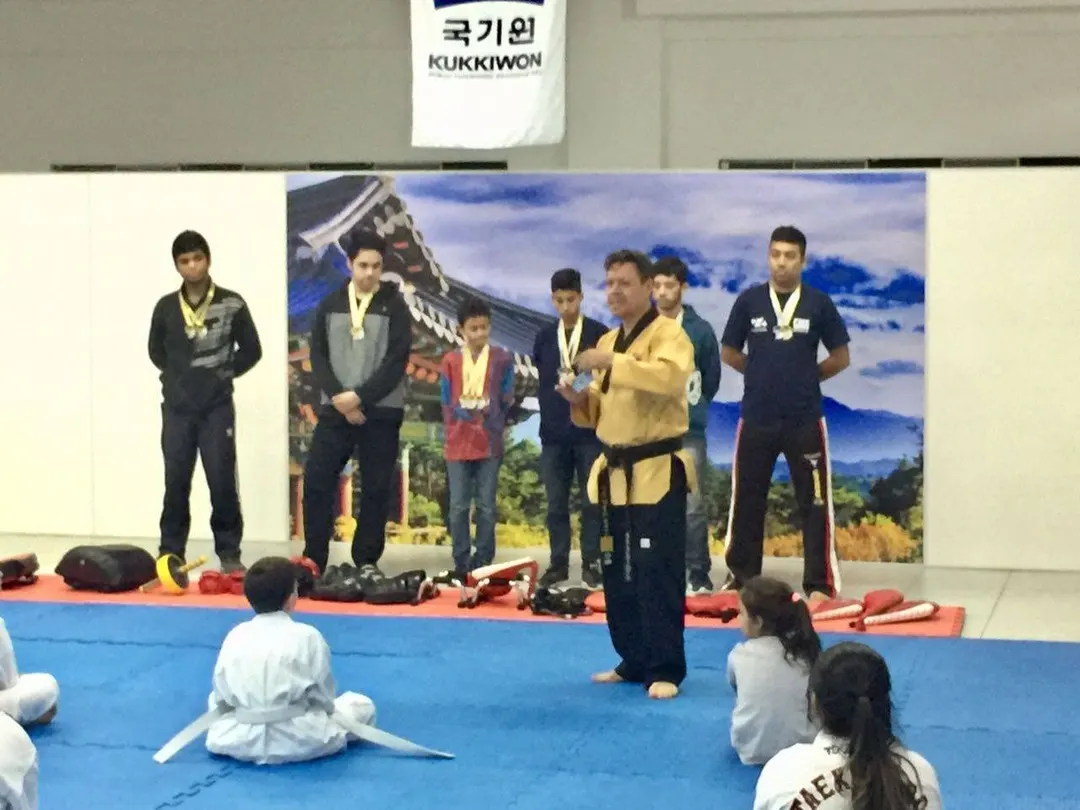
Taekwondo brings children measurable benefits in attention and self-control: that is what three randomized clinical trials show, the most reliable type of study for this kind of question. One followed 240 children aged 7 to 11 in UK schools for 11 weeks; another, 40 children aged 7 to 8 for 8 weeks; the third, 30 schoolchildren for 16 weeks. None of them promises miracles, and each has limits that this article explains in plain English. At the end is what Mestre Paulo Ribeiro has observed for more than 20 years in Balneário Camboriú, presented as his opinion, not as data.
Why look only at clinical trials
Online, every gym says martial arts “improve discipline”. To separate advertising from evidence, this article uses only randomized clinical trials: studies in which children are randomly assigned to a group that trains Taekwondo or a group that does not (or does ordinary physical education), and both groups are measured before and after. This design reduces the chance that the result comes from something else, such as the family’s prior interest.
Even so, three studies do not settle the question. They show trends, with small samples and short time frames. Each one is worth reading with its limits in mind.
Study 1: 240 children, 11 weeks, United Kingdom
The trial by Ng-Knight and colleagues, published in the journal Developmental Psychology in 2022 (PubMed), is the largest of the three. According to the description in the BMC Sports Science, Medicine and Rehabilitation article that cites it, it involved 240 children aged 7 to 11 in British primary schools, randomly assigned to an 11-week introductory Taekwondo program during school hours or to a waiting list. Attention and self-regulation were measured through teacher ratings and computerized executive attention tasks.
Result: children in the Taekwondo group improved more in attentional control and self-regulation than those in the control group.
Limits: 11 weeks is too short to know whether the gain lasts; the program was delivered at school, a different setting from a gym; and the control group did no other physical activity, so it is impossible to say whether the effect comes from Taekwondo itself or from any structured sport.
Study 2: 40 children, 8 weeks, compared with physical education
The trial published in February 2026 in BMC Sports Science, Medicine and Rehabilitation resolves part of that doubt. Forty children aged 7 to 8 were randomly assigned to a structured Taekwondo program (three 45-minute sessions a week, at an intensity of at least 60% of maximum heart rate) or to regular physical education classes. Attention was assessed before and after in four dimensions: stability, distribution, switching and span.
Result: the Taekwondo group improved more in attention stability (staying focused) and switching (changing tasks). In attention distribution, both groups improved similarly. In span, there was no effect.
Limits: a small sample (20 children per group), 8 weeks long, and the trial was registered after it began, as the authors themselves report. It is a promising result, not a definitive one.
Study 3: 30 children, 16 weeks, blood markers
The study published in 2017 in the International Journal of Environmental Research and Public Health (PubMed) took another route: besides testing cognition, it measured blood factors linked to brain plasticity. Thirty healthy schoolchildren were randomly assigned to a Taekwondo group or a control group, with 16 weeks of training.
Result: the Taekwondo group showed higher levels of BDNF, VEGF and IGF-1 (proteins associated with the growth and adaptation of neurons and blood vessels) and a higher score on the color-word part of the Stroop test, which measures the ability to inhibit an automatic response. There was no difference in cerebral blood flow velocity.
Limits: 15 children per group is a very small sample; and a blood marker is not the same as school performance.
What this means for parents
Putting the three studies together, we can honestly say:
- There is evidence of gains in attention and self-control in children aged 7 to 11 after 8 to 16 weeks of structured Taekwondo.
- The comparison with ordinary physical education (study 2) suggests that the class format, with rules, sequences and directed effort, matters.
- No study measured grades or followed the children for years. Anyone who promises “better report cards” is going beyond what science shows.
- Aggression did not increase in any of the trials; the trend was the opposite, with more self-regulation.
These results match what happens in a well-run class: waiting your turn, repeating a movement until you get it right, returning the bow, controlling your strength on contact. How these values show up in the gym’s routine is on the page about Taekwondo classes.
What Mestre Paulo sees in Balneário Camboriú
Here the source changes: it is no longer a study but a teacher’s experience. Mestre Paulo Ribeiro has worked for more than 20 years with children and adults in Balneário Camboriú and created Projeto Campeões do Futuro (“Future Champions”), which offers free sport to children and teenagers after school hours. In November 2020, he described the project’s goal as “to give students the opportunity and encouragement to practice sport and the culture of sport combined with education”, for “all-round development, such as building citizenship and improving quality of life” (our translation; Instagram).
What he reports seeing in his classes, which matches what the studies measured in the lab, is the child who arrives restless and learns to wait, the shy child who learns to answer the bow out loud, and the child who discovers that repeating a kick a hundred times is the path to the next belt. A concrete example of his work in schools is in the article on Campeões do Futuro at the João Goulart school. The structure of the classes is on the Taekwondo page.
What has not yet been confirmed
- The minimum age and current schedule of the Mestre’s children’s classes have not been confirmed for this article.
- All three studies were carried out outside Brazil; no equivalent Brazilian clinical trial was found.
- Study 1 was read through the description in study 2 and the PubMed record; the full text was not opened in this research.
Bring your child to try a class
The best way to find out whether Taekwondo is right for your child is to watch them in a class. Read the Mestre’s story and contact him on Instagram @mestrepauloribeiro to book a trial class in Balneário Camboriú.
Frequently asked questions
Does Taekwondo improve children’s attention?
Two randomized clinical trials point that way: one with 240 children aged 7 to 11 in the United Kingdom (11 weeks) and another with 40 children aged 7 to 8 (8 weeks). Both measured attention gains in the group that trained Taekwondo compared with the control group.
From what age can a child do Taekwondo?
The studies cited worked with children from age 7. The minimum age in Mestre Paulo Ribeiro’s classes in Balneário Camboriú has not been confirmed for this article; ask him directly.
Does Taekwondo make children more aggressive?
That is not what the studies indicate. In the 2022 British trial, the group that trained Taekwondo improved in self-regulation and attentional control compared with the control group. Classes are built around discipline and respect.
How many classes a week does a child need?
In the 2026 trial, there were three 45-minute sessions a week for 8 weeks. In the 2017 trial, five a week for 16 weeks. There is no single number; frequency depends on the class and the family’s routine.
Sources
- Does Taekwondo improve children’s self-regulation? Ng-Knight et al., Developmental Psychology, 2022 – PubMed
- The effect of taekwondo structured training on attention in 7–8-year-old children – BMC Sports Science, Medicine and Rehabilitation, February 10, 2026
- The Effects of Taekwondo Training on Peripheral Neuroplasticity-Related Growth Factors… in Healthy Children – IJERPH, 2017 (PubMed)
- Post about the Campeões do Futuro project – Mestre Paulo Ribeiro, Instagram, November 3, 2020
Want to support the project?
See how companies and people in Brazil support sport through their taxes, or talk directly to the Master.
Read next
State public utility status: what the title gives a federation
FECAMTT received state public utility status under Law 19,281/2025. What it means, what it does not mean and how a federation applies.
· 8 min read
After-school sports in Brazil: what the law supports and how it works
After-school sports in Brazil: how the Sports Incentive Law, PIE/SC and Fundesporte treat projects for children, with a Balneário Camboriú example.
· 5 min read
How to get corporate sponsorship for a sports project in Brazil
How to get company sponsorship for a sports project in Brazil: PIE/SC, the Sports Incentive Law or direct sponsorship, what to bring, what not to promise.
· 5 min read